
Advanced Google Ads Optimization for Agencies
Master Google Ads optimization with advanced tactics for multi-account teams. Learn to audit conversion signals, refine bidding, and scale operations
google ads optimization, ppc management, ad operations, smart bidding, campaign audit
Most Google Ads optimization advice starts in the wrong place. It tells you to change bids, open broad match, activate Smart Bidding, or move spend into Performance Max. Those decisions matter, but they’re downstream decisions. If the conversion signal is weak, automation can scale the wrong outcome faster, and a cleaner-looking dashboard can hide poorer business performance.
Across multiple client accounts, the durable advantage comes from governance before adjustment. That means defining which outcomes deserve optimization, separating diagnosis from decision-making, testing one material change at a time, and adapting reporting as Google expands automated inventory. Bid changes are only useful when the system is learning from trustworthy business data and the team can execute decisions consistently.
Table of Contents
- Governing the Conversion Signal Before Touching Bids
- Using Quality Score as a Diagnostic Framework
- Running Controlled Experiments for Bidding Changes
- Isolating Variables in Creative and Ad Copy Testing
- Adapting to AI Overviews and Shifting Inventory
- Scaling Execution Across Multiple Client Accounts
Governing the Conversion Signal Before Touching Bids
A platform conversion isn’t automatically a valuable conversion. A form submission may be duplicated, incomplete, outside the service area, or impossible for sales to qualify. A purchase may be real but unprofitable. If every event enters bidding with the same status, Google’s automation has no reliable way to distinguish a promising customer from a cheap but useless action.
That’s why advanced Google Ads optimization starts with the signal, not the bid strategy. The account should reflect the commercial hierarchy behind the campaign:
- Initial response: A form fill, phone call, chat, or checkout event confirms an interaction.
- Qualified outcome: A CRM stage confirms that the prospect fits the offer, location, budget, or sales criteria.
- Commercial result: An accepted opportunity, closed deal, profitable sale, or new customer carries the strongest business meaning.
The practical work is to connect those stages without allowing every stage to distort bidding. Import CRM and offline outcomes where the sales cycle requires them, assign distinct values to qualified leads and closed revenue, and exclude duplicate or low-quality events from the primary optimization set. Keep softer events available for diagnostics when useful, but don’t let them define success on their own.
A conversion audit for agency accounts
Start with a simple event inventory. For every conversion action, record its source, owner, definition, delay, deduplication rule, and role in bidding. A useful audit asks:
- What exactly triggers the event? Check whether the event fires once per meaningful action or repeatedly during the same journey.
- Who validates it? Marketing, sales, finance, or nobody should own the definition.
- What happens after the event? Map the next CRM stage and whether it can be returned to Google.
- Does the value reflect economics? A qualified enterprise opportunity shouldn’t be treated as interchangeable with an unverified inquiry.
- How quickly does the outcome arrive? Long sales cycles require careful interpretation of recent platform results.
Recent practitioner coverage identifies a practical learning threshold of roughly 20 to 30 trusted conversions per month for automation, but that threshold only helps when those conversions represent genuine business value. The distinction between a lead, a qualified lead, a sale, and a profitable sale matters more than the raw event count. Recent practitioner coverage on Google Ads trends makes the same limitation clear: clean first-party and offline outcome data increasingly determines whether automation learns the right objective.
Practical rule: Never solve a bad signal with a more aggressive bid strategy.
Standardize the operating layer
Multi-account teams need a repeatable governance document, not a collection of individual analyst preferences. Define naming conventions, primary conversion rules, value policies, import ownership, and escalation criteria. A new client should enter the same review process whether the account sells software, professional services, or physical products.
A conversion gateway can help teams centralize and validate events before they reach advertising platforms. For teams evaluating implementation patterns, this guide to a conversions API gateway offers useful context on routing and managing conversion data. The technology doesn’t replace commercial judgment, though. Someone still has to decide which CRM stage represents meaningful value and how revenue should be assigned.
The most dangerous account is not always the one with the highest CPA. It’s the one reporting an attractive CPA from events that sales can’t use. Fix the definition, latency, deduplication, and value assignment first. Only then can a bidding change answer a meaningful business question.
Using Quality Score as a Diagnostic Framework
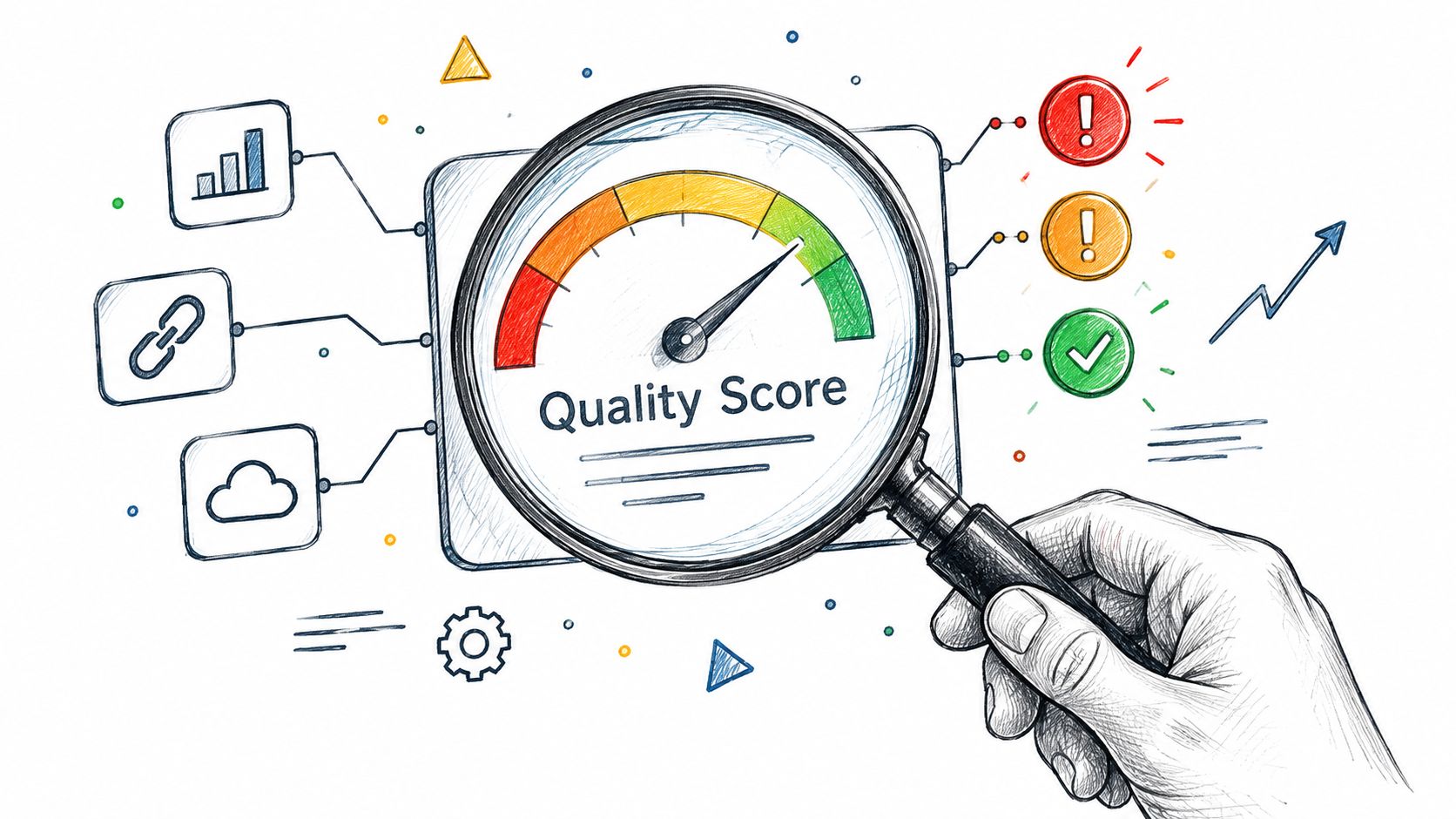
Quality Score is useful when it tells you where the experience is misaligned. It becomes harmful when the team treats the visible number as a target. Google reports Quality Score on a 1 to 10 scale at keyword level and evaluates it through expected click-through rate, ad relevance, and landing-page experience. Google also states that the score isn’t an auction input or a key performance indicator, so an account shouldn’t celebrate a higher score without checking qualified conversions, acquisition cost, and revenue. Google’s Quality Score documentation defines the metric as a diagnostic comparison based on ads shown for the same search over the previous 90 days.
Read the components, not just the score
Use the component labels to determine the next investigation:
| Component | What to inspect | Typical operational question |
|---|---|---|
| Expected click-through rate | Search intent, historical response, and message strength | Does the ad offer a reason to choose this result? |
| Ad relevance | Keyword-to-ad-group and query-to-copy alignment | Does the wording answer the searcher’s specific need? |
| Landing-page experience | Relevance, usefulness, clarity, and continuity | Does the page deliver what the ad promised? |
If expected click-through rate is below average, review the promise and the search context before changing bids. If ad relevance is weak, tighten the relationship between query themes and ad messaging. If landing-page experience is weak, improve the destination rather than asking the ad to compensate for a poor post-click experience.
The sequence matters. Start with the component marked below average, then compare the query, the ad, and the page as one journey. Don’t rewrite every headline, split every ad group, and rebuild the landing page at the same time. That creates activity without a clean diagnosis.
Use the historical window responsibly
The comparison window means a daily fluctuation shouldn’t trigger an account-wide reaction. In multi-account operations, analysts often see a visible change before there’s enough history to interpret it. Review the underlying search volume, query mix, ad eligibility, and business outcome before declaring a structural problem.
A low score can coexist with strong commercial performance, while a high score can coexist with poor lead quality. The right question isn’t “How do we raise this score?” It’s “Which component reveals friction that we can fix without damaging profitable demand?”
Teams researching emerging companies may also find it useful to find newly funded startups when building prospecting lists or testing new commercial segments. The relevance to paid search is operational: new market categories often require more careful intent, copy, and landing-page alignment before a score tells you much.
For a broader visual explanation of account diagnostics and optimization mechanics, use the following walkthrough:
Running Controlled Experiments for Bidding Changes
Smart Bidding isn’t a set-and-forget button. It’s a decision system that needs a valid measurement environment. When a team changes the strategy, budget, match type, landing page, targeting, and conversion definition together, the resulting movement may look impressive while revealing nothing about causality.
A controlled experiment should begin with one primary business metric. Choose qualified conversion rate, incremental CPA, conversion value, or ROAS before launch. Clicks can help explain behavior, but they shouldn’t decide whether a major bidding change rolls out.
Protect the comparison
The treatment and control need comparable conditions. Preserve targeting, budgets, attribution, conversion definitions, and relevant audience settings unless one of those is the explicit variable under test. If the treatment uses a different conversion definition or receives a materially different budget, the experiment no longer answers the original question.
A disciplined setup follows this order:
- Write the hypothesis. For example, a bidding change may improve qualified pipeline efficiency without reducing volume.
- Choose one major variable. Don’t pair a strategy change with a landing-page redesign.
- Set the decision metric. Use the business outcome that determines rollout.
- Define the observation period. Capture weekday and weekend behavior rather than judging an isolated burst.
- Set the stopping rule. Don’t stop because the chart looks favorable.
- Review operational meaning. A statistically credible result still needs to matter after margin, sales capacity, seasonality, and tracking noise.
Google Ads experimentation guidance gives a practical benchmark of approximately 400 conversions per arm to detect a 20% lift at 95% confidence, compared with roughly 1,600 conversions per arm for a 10% lift. Experiments commonly need at least four weeks to reduce distortion from weekly traffic patterns. Google’s experiment guidance provides the relevant reference point, but the benchmark isn’t a license to force a test where the account lacks enough trustworthy outcomes.
Don’t confuse movement with evidence
Early wins are seductive. A treatment can lead after a short period because of query mix, auction conditions, delayed conversions, or random variation. Stopping early turns noise into a rollout decision, especially when the account has a long conversion lag.
The same problem appears when agencies test across client accounts and pool the results casually. Accounts differ in margin, audience, sales process, tracking quality, and demand maturity. A shared playbook can standardize the test design, but it can’t make unrelated accounts interchangeable.
The final decision should ask whether the change creates incremental business value, not whether Google reported cheaper clicks. If the strategy improves platform CPA while qualified pipeline falls, it failed. If it increases reported cost while producing better customer quality, the result deserves a more careful commercial review.
Isolating Variables in Creative and Ad Copy Testing
Creative testing fails when the team changes the message and the destination in the same release. If the new ad gets more qualified conversions, you won’t know whether the improvement came from the headline, the offer, the landing page, the audience mix, or a seasonal shift. That uncertainty makes the result difficult to reuse across other accounts.
The cleanest ad test changes one major creative variable while holding the rest of the environment stable. In a responsive search ad workflow, that might mean testing a new value proposition against an existing message set while keeping the landing page, campaign targeting, conversion definition, and bidding conditions consistent. A practical reference for structuring and managing responsive search ads can help teams document those relationships before launch.
Test the message buyers actually respond to
A useful creative hypothesis is specific enough to fail. “Better copy” isn’t a hypothesis. “A message focused on implementation speed will attract more qualified software inquiries than a message focused on feature breadth” gives the analyst something to measure and a reason to inspect lead quality afterward.
Separate the role of each test:
- Promise test: Compare the central benefit or outcome.
- Proof test: Compare evidence such as process detail, credentials, or product capability.
- Action test: Compare the next step and the friction associated with it.
- Qualification test: Make the fit clearer to reduce low-value responses.
CTR can reveal whether the message earns attention, but conversion rate and downstream quality determine whether that attention is commercially useful. A stronger ad that attracts more unqualified traffic isn’t a winner. Conversely, a message with a modest response rate may deserve expansion if it produces better opportunities.
Keep the rollout clean
Once a treatment wins, don’t immediately replace every related ad and restructure the campaign. Record the exact claim, audience context, query theme, destination, and business metric behind the result. Then deploy the insight selectively into closely related ad groups or campaigns.
Agencies often contaminate their own learning here. A buyer sees a promising message, copies it into several campaigns, changes assets, and then attributes the next movement to the original test. Maintain a test register with the hypothesis, launch date, control, treatment, metric, and implementation status. Use the result as a reusable decision, not a vague creative preference.
Creative testing also has to respect the conversion signal. If the account optimizes toward an unqualified form, the winning copy may just be the copy that attracts the easiest forms. Governance and experimentation are connected. The ad can only be judged correctly when the account recognizes the difference between response and value.
Adapting to AI Overviews and Shifting Inventory
Google Ads inventory no longer fits neatly into isolated channel boxes. Search, automated placements, and AI-assisted results can overlap in ways that make platform-reported efficiency harder to interpret. The operational question has shifted from “Which channel has the best CTR?” to “Which placement creates profitable incremental demand?”
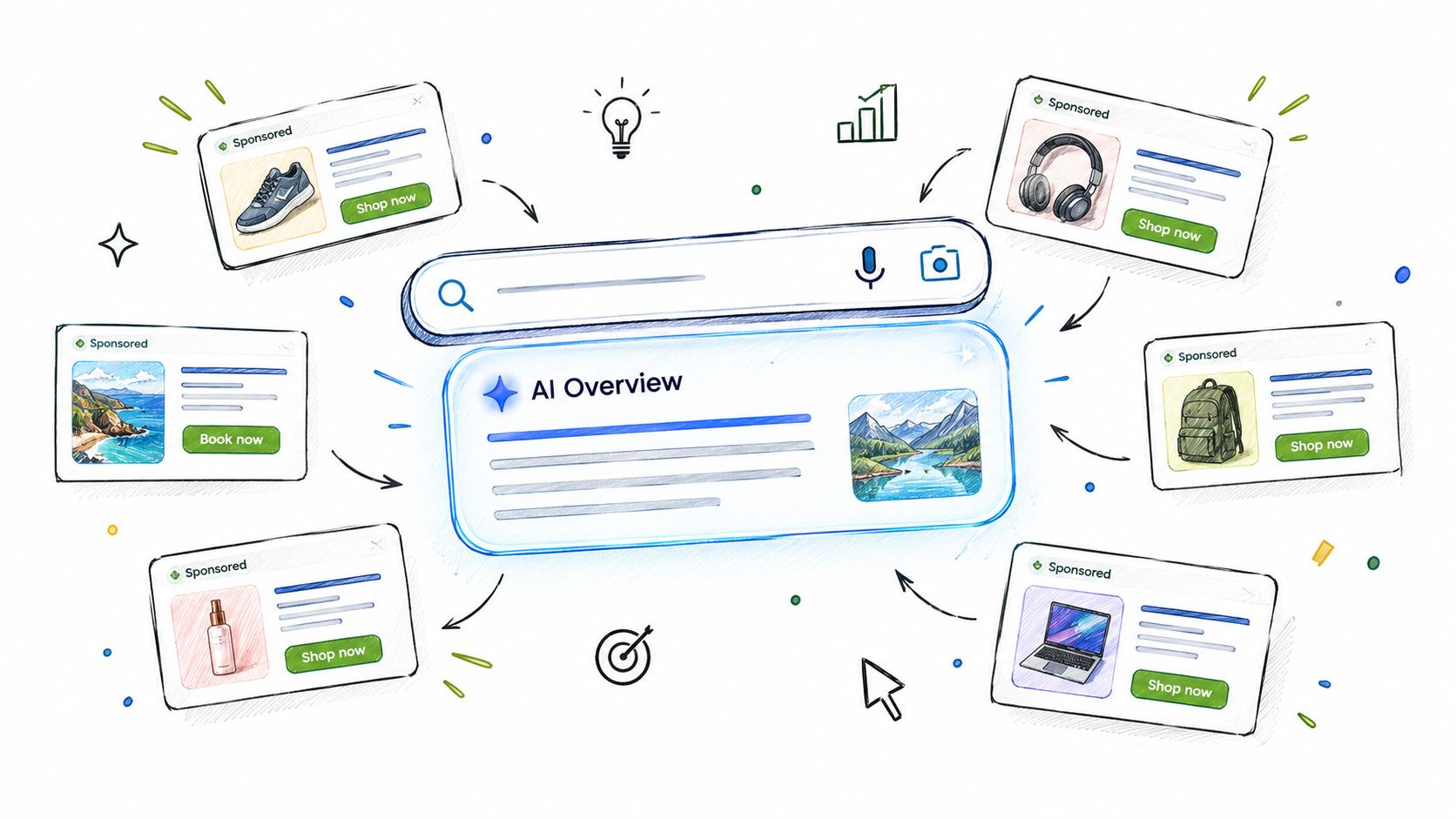
Google reported that ads in AI Overviews launched in the United States and later expanded to desktop and additional countries globally. Independent industry data found ads alongside AI Overviews increased from about 3% of observed AI Overview results in January 2025 to roughly 40% by November, while ads appeared at the bottom of around 25% of AI Overview search pages. Google’s documentation on ads in AI Overviews provides the platform context for this inventory shift.
Separate demand types before judging performance
A lower reported CPA can hide cannibalization. Branded searches, returning users, nonbranded prospecting, and automated placements don’t carry the same incrementality. Put them into separate reporting views where possible, then compare customer quality and marginal profit rather than combining everything into one efficiency figure.
A practical inventory review should include:
- Brand-query controls: Monitor whether automation is capturing demand that already knew the company.
- Search-term diagnostics: Review interpreted intent, emerging query themes, and irrelevant demand.
- Placement visibility: Identify where reporting is available and flag areas where attribution remains unclear.
- Geo and device comparisons: Use holdouts or structured comparisons where the account and market allow them.
- Marginal-profit thresholds: Define the maximum acceptable cost for an incremental customer, not just a platform conversion.
Teams also need content and landing pages that answer complex informational journeys clearly. For a complementary perspective on how to structure content for AI Overviews, review the practical guidance from Stimulead. The paid and organic sides aren’t identical, but both require sharper intent mapping and a more deliberate answer to what the user needs next.
Report uncertainty instead of hiding it
AI-assisted inventory can change how users interpret a result, where they click, and which interaction receives credit. That makes placement-level certainty dangerous. A dashboard should distinguish observed platform results from validated incremental outcomes.
A buyer may keep a campaign active when automated inventory expands reach but fails the customer-quality threshold. Another campaign may tolerate a higher reported CPA if it brings new customers who generate acceptable profit. These decisions require segmentation by brand status, prospecting status, customer type, and commercial value.
For teams adapting their operating model, AI for Google Ads offers relevant context on how automated assistance can support analysis. The tool doesn’t remove the need for controls. It increases the importance of documenting what the system can inspect, what the analyst can approve, and which outcomes justify continued spend.
Scaling Execution Across Multiple Client Accounts
Finding an optimization opportunity is only half the job. The agency bottleneck appears between diagnosis and execution, when an analyst spots wasted spend in one account, identifies a budget issue in another, and then spends the day moving between interfaces, exports, dashboards, and approval threads.
The answer isn’t to automate every decision. It’s to centralize the operating layer while keeping decision rights explicit. A team needs consistent access to account structure and performance, a shared record of recommendations, and a controlled route from approved action to implementation. Without that layer, every client account develops its own undocumented exception.
Turn recurring work into governed operations
Start by separating analysis from authorization. Analysts can identify campaigns that need review, but changes should follow predefined constraints. New creations should start paused, destructive actions should be restricted, and every modification should produce a permanent record containing the account, request origin, change details, and outcome.
A scalable workflow typically includes:
- Unified observation: Read account structure and performance in a consistent format across connected networks.
- Playbook context: Apply brand rules, account exceptions, budget policies, and naming standards before proposing action.
- Approval boundaries: Decide which actions are allowed automatically and which require human approval.
- Safe execution: Prevent hard deletes and unintended targeting changes, and keep new entities paused until reviewed.
- Auditability: Preserve the full activity history so another buyer can understand what changed and why.
This structure matters more as the client roster grows. A recommendation that sits unresolved for days can waste more budget than a single imperfect bid decision. Operational latency is a performance variable, especially when teams manage many markets, brands, or accounts simultaneously.
Choose tools by their write scope
A dashboard that reports a problem isn’t the same as an operations system that can resolve it. Before connecting any AI assistant or automation layer, document its read permissions, write permissions, safety constraints, credential handling, and rollback process. The system should make boundaries visible rather than assuming that more access equals better optimization.
AdCrunch is one example of an AI-native operations toolkit that connects Meta, TikTok, and Google Ads for consistent account and performance analysis, while its documented Google Ads access is currently read-only. Its broader workflow supports agent connections, structured playbooks, paused creations, and permanent activity logging, with write actions documented for Meta rather than Google Ads. That distinction matters. Teams should evaluate a platform on the actions it supports, not on a generalized promise of autonomous account management.
Centralization also reduces context loss. An analyst can compare recurring issues across accounts, standardize the audit trail, and route approved work through the same process instead of relying on memory. The goal isn’t to remove human judgment. It’s to reserve human judgment for signal quality, experiment design, commercial trade-offs, and exceptions, while governed tooling handles repetitive inspection and execution where appropriate.
The strongest agency model combines trusted conversion data, controlled experimentation, diagnostic metrics, and accountable operations. Bids remain part of the toolkit, but they’re no longer treated as the main lever. Teams that manage the signal and the workflow will make better decisions than teams that just make more changes.
If your agency is losing time between identifying account issues and acting on them, AdCrunch can centralize cross-platform account analysis and connect your operating playbooks to governed ad workflows. Use it to create a clearer audit trail, reduce tool switching, and build a more controlled optimization process across your client portfolio.